LTO tape · 3-2-1 catalog · Windows + Linux · 2026

Hibernate your
archive. Wake it
when you need it.

Petabyte-scale LTO tape archive with built-in 3-2-1 across disk, NAS, and cloud. Integrity-checked. Open format. Your infrastructure.

Hiberden is modern archive software for media production, broadcast, and research teams that have a lot of data and want to keep it. We built it around LTO tape because tape is the only medium that's air-gapped by default, cheap at scale, and still readable in twenty years — and because the cloud-only crowd can't actually satisfy 3-2-1 on their own.

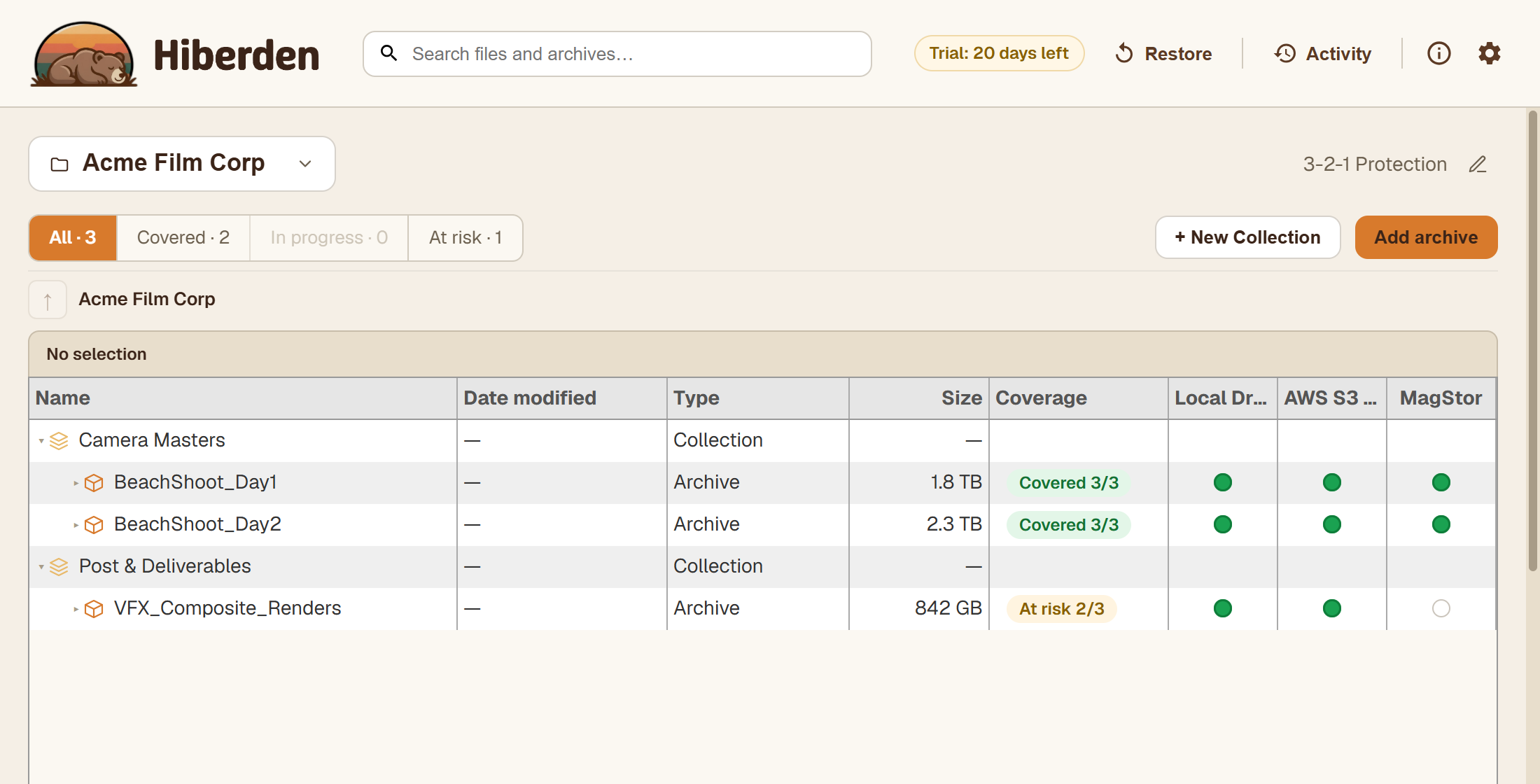
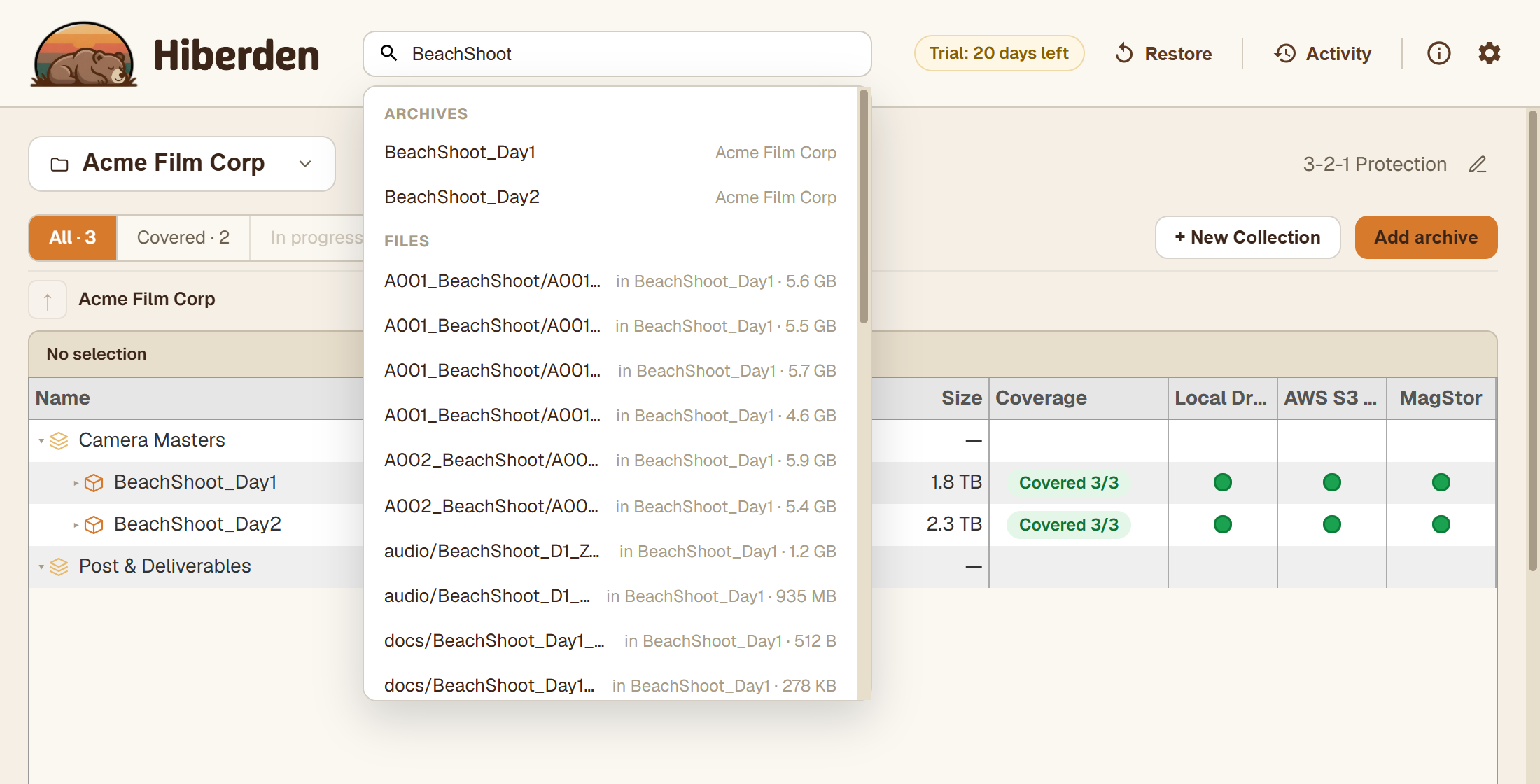
Around the tape spine, Hiberden writes integrity-checked copies to local disk, NAS, and cloud, all tracked in a single catalog so you always know where every file lives. Open format. No lock-in. A virtual tape emulator ships in the same binary, so the whole product is evaluable on a laptop without owning a drive.

  • Windows 10+
  • Linux (deb, rpm, AppImage)
  • Evaluate without a drive. Archive with one.
Mountain landscape at sunset

The 3-2-1 rule

The backup rule that survived ransomware — built on tape.

Three copies of your data. On two different kinds of storage. At least one offsite. The rule has been around for twenty years, but the tooling has been hostile — one vendor for tape, another for NAS sync, a third for cloud, no single way to see what you've actually got.

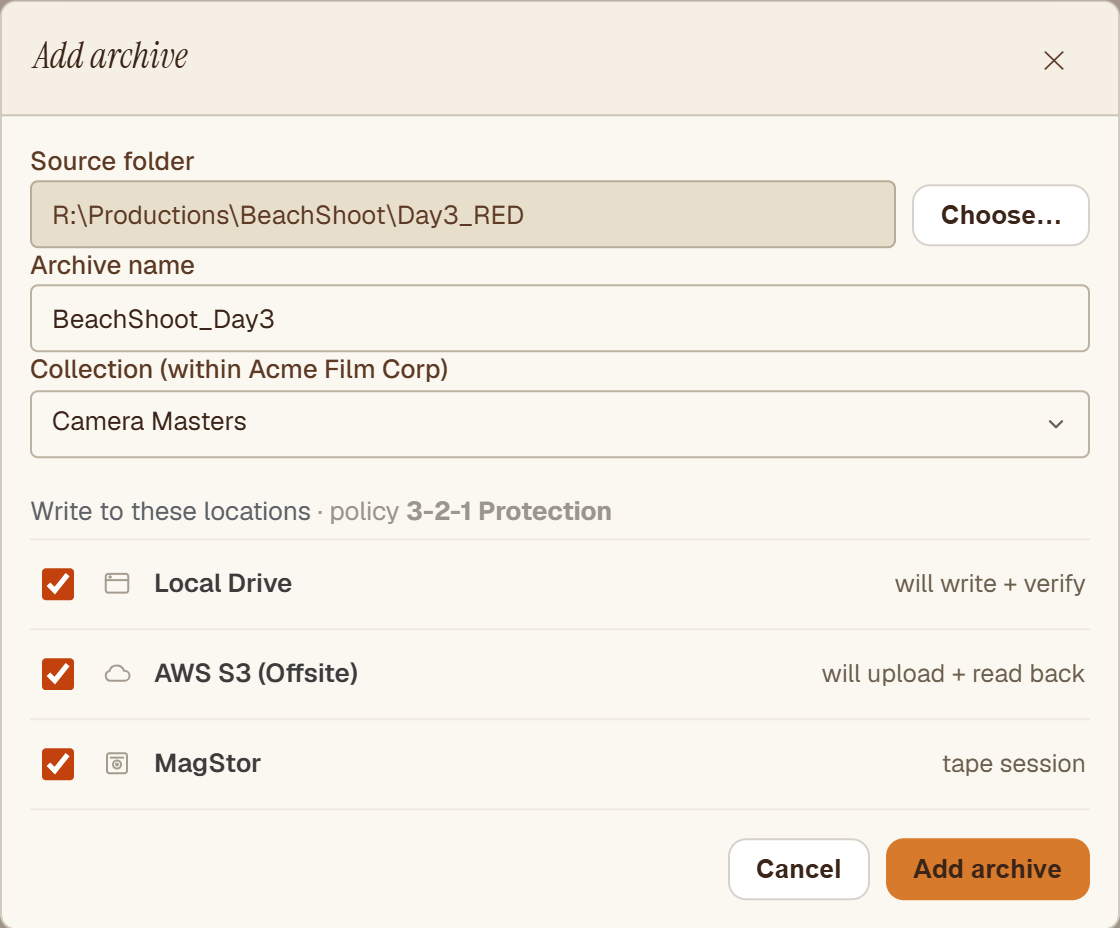
Hiberden makes 3-2-1 the default. One archive operation writes to every copy in your plan. Each copy is verified independently with an integrity check. A unified catalog tracks every copy of every file across every medium. When ransomware comes for the backups — and it does — your offsite, air-gapped tape is exactly where it's supposed to be, with an integrity check that proves it's still the file you wrote. Tape is the spine of the plan because tape is the only medium that's offline by default. Everything else is the copies around it.

Media plan

Four kinds of copy. One catalog.

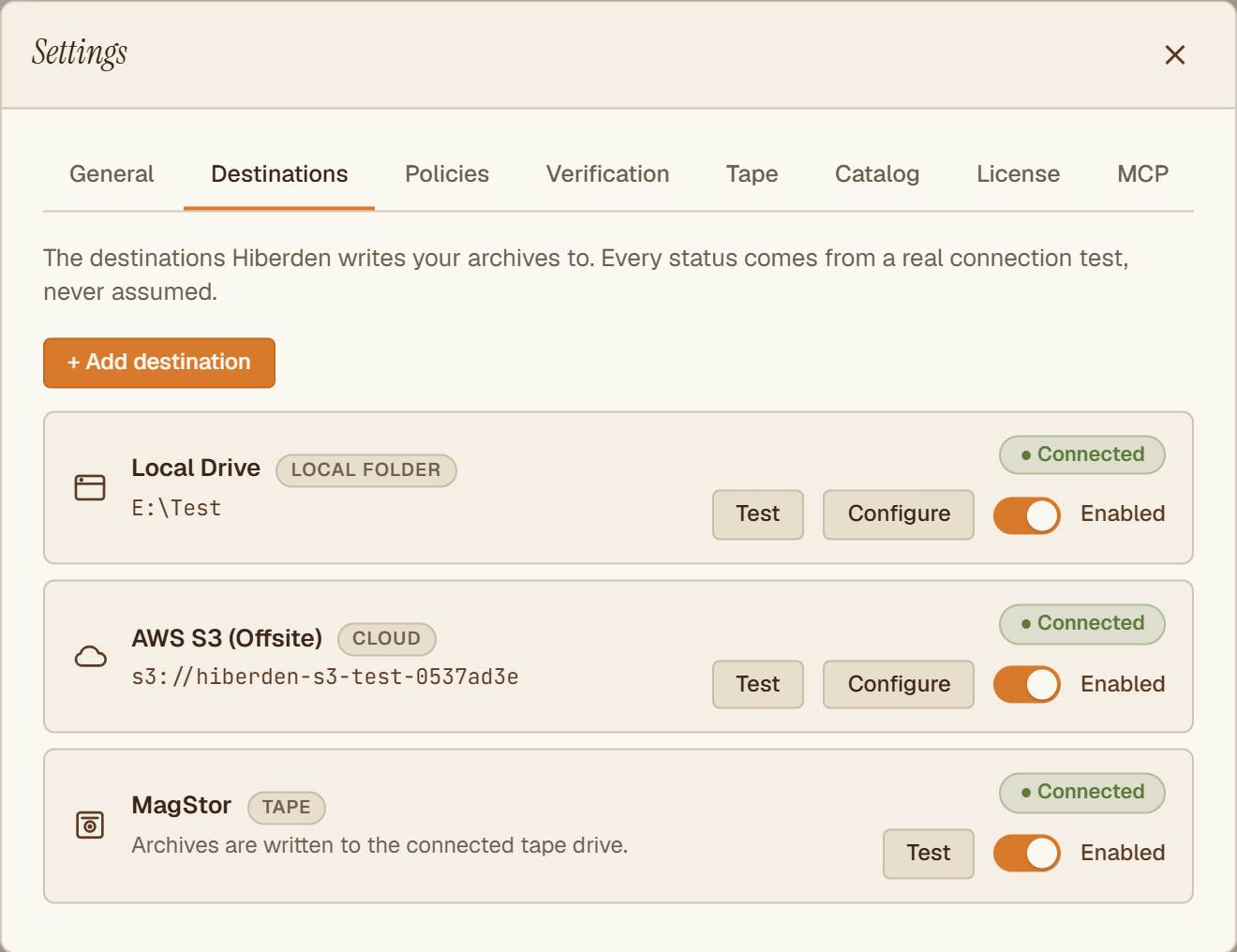
Every Hiberden archive plan is anchored on tape and surrounded by the other copies a real 3-2-1 plan needs. Mix and match — tape and cloud, tape plus NAS plus cloud, two tape copies and a disk, whatever fits the work. The catalog tracks them all the same way.

  • Local disk

    Fast restore, low complexity. Any path Hiberden can write to — internal drive, attached storage, anything that looks like a folder. The same integrity-checked write path as tape.

  • NAS

    A network share is a folder to Hiberden. SMB, NFS, anything Windows or Linux can mount. Useful as a working second copy when tape is slow to mount and cloud is slow to restore from.

  • Cloud

    S3-compatible object storage in your own cloud account. AWS, Backblaze B2, Wasabi, MinIO, whatever you already pay for. Hiberden never holds your cloud credentials on its servers — your storage, your account, your bill.

Every copy is integrity-checked. Every file is in the catalog. Restore from whichever copy makes sense for the situation.

Ownership

Your data. Your infrastructure. Your keys.

Hiberden is software you install, not a service we host. Your tapes sit in your library. Your NAS shares run on your network. Your cloud buckets are in your cloud account, paid directly to your cloud provider. We never see your files.

The catalog database lives on your machine — SQLite at the desktop tier, PostgreSQL at the library and enterprise tiers. You can move it, back it up, or audit it without asking us.

If you ever stop using Hiberden, your tapes are still readable in their open, documented format. Your local copies are still files. Your cloud buckets are still in your account. There is nothing to migrate off, because nothing was ever locked in.

Evaluate

Try the whole product before you buy a drive.

The full product — UI, catalog, write path, verification, restore — ships with a virtual tape emulator that behaves like a real drive. Download, run, evaluate the whole 3-2-1 architecture on a laptop. When you're ready to buy hardware, the same archives import directly onto real tape.